
Image: A small crowd, including one person in a wheelchair, wait for a light on a Berkeley curb (with curb cut-- a relative rarity for the time), ca. 1977.
I feel like half of my posts refer to Wheelchair Dancer, but that won't stop me from making more..
In her thoughts on Universal Design
here, she raises some interesting distinctions between functionality in design and what she calls "potential" -- the difference, as I read it, between designing for specific disabilities and designing for the body in a broader, maybe more imaginative sense.
In a lot of my writing I use the term "accessible" design separately from "Universal"-- Universal refers, I think, to a specific aspiration in design to try to include the broadest spectrum of users, and is rooted in a historical moment when the design world became aware of Disability Rights. Accessible is a kind of bare-minimum, as in "usable" (functional, in WD's discussion) by people with particular impairments. ADA compliance is accessible design; Universal Design goes beyond (and can even violate) codes and regulations.
She also quotes from a UC Berkeley course description for a studio on "Body-Conscious Design" in which students learn "to evaluate and design environments from the point of view of how they interact with the human body." The specific terms "disability," "accessibility" and "universal" appear nowhere, but clearly this course and its approach come out of the last 30+ years of experimentation in the design world around issues of access and usability; it also recalls Berkeley's legacy as a city and university on the forefront of Disability politics (see above). The language in the description points, I think, to the particular way that design can fulfill a certain dream (or even cliche) of Disability Rights-- that people should be seen in terms of their abilities, not disabilities. I don't want to recall the hackneyed language of "handicapable!"-- but, from the design perspective, functionality really is about ability: what is required of the body to open doors, read signs, operate machines/tools -- and, further, to feel comfortable, supported, welcome?
Another aspect here is what design can't do. In the worlds of sustainable/environmental design, some people have started to propose flexibility as a principle-- that things, forms, systems need to be able to change to accommodate new problems and new learning. Out of necessity, regulations like the ADA require specific benchmarks (this height/grade ramp, this width doorway, this sonic/tactile alert system)-- but they have to be seen as a first step only. To really respond to users, a designed system/space/object should allow the user to respond to it, to change it or rearrange it. I'm keeping my eye out for examples of this approach.. and will report if I find them.

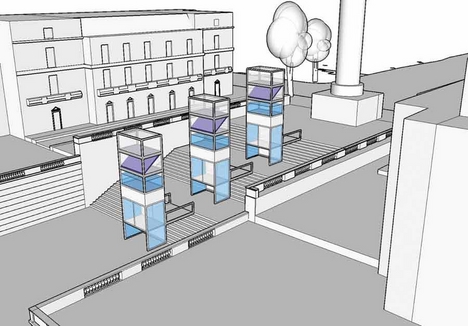 Image: Computer drawing of the three-tiered Duke of York steps, with the mock-ups of three glass towers installed on the landings to house wheelchair lifts.


 Posts
Posts


