A blog about universal and accessible design

Showing posts with label architecture. Show all posts

Thursday, March 24, 2011

Ed Roberts campus opens in Berkeley

East Bay folks, take note - the new Ed Roberts campus, a community service center located at the Ashby Ave BART station in south Berkeley, is opening April 9. I am a bit fuzzy on the details, but I believe this gorgeous, universally-designed building with a large central spiraling ramp (reminiscent of the Guggenheim) will house several of the major disability organizations in Berkeley (but correct me if that is wrong). This image of the center (which I believe is a computer projection) is from worldarchitecturenews.com.

The campus is named for Ed Roberts, dubbed by some "the father of the disability rights movement," a MacArthur genius award-winning activist who lived in Berkeley for most of his adult life, starting in 1962 when he became the first student with physical disabilities to live on campus at UC Berkeley. Roberts was also a founder of the Center for Independent Living and the World Institute on Disability. Here's a picture of him and Herb Willsmore, a fellow student at Berkeley, at the University's stadium, from the Disabled Students Program Photograph Collection at UC Berkeley's Bancroft Library.


Monday, January 31, 2011

Worlds with and without stairs II


Above is a video that has been circulating in my facebook feed and various blogs, showing an experiment to see if altering the experience of walking up stairs would change people's likelihood of taking the stairs rather than the escalator. It's pretty cute and simple, and it's nice to see people having a fun time in the mundane setting of a subway station. This is not a strictly "accessible" form of design, though it does play off of choice between ways of moving through a place, which does have to do with physical access. And it makes me wonder - how much do designers think about stairs? Are they inviting, discouraging, or just plain functional? In a world when we often have the choice of elevator, escalator, stairs or ramps, could designers make these experiences more distinct?


When I first started this blog, I posted about the idea of a "world without stairs" - wondering whether an accessible world could actually mean the disappearance of such a standard architectural feature as the stairs.

I've learned a few things since then... one is, of course, that stairs are just one kind of physical barrier, for one kind of access issue. In fact, many people with disabilities prefer stairs to ramps - for example, if they use a prosthetic leg or a cane, that straight platform can be easier to use. The first ever Architectural Standard in the U.S. included not only measurements for ramps, but design guidelines for stair heights and angles that would not interfere with those who needed to drag their feet up the front of stairs:


(image: figure showing unacceptable and acceptable stair designs, from the 1961 American National Standards Institute's Specifications for Making Buildings and Facilities Accessible to, and Usable by, the Physically Handicapped, which became the guidelines for state and federal accessibility laws in the 1960s and 70s).

In my earlier post on stairs, I noted some architectural examples (such as the Guggenheim) that used alternatives to stepped surfaces as a design feature. These were not spaces explicitly designed for wheelchair use (in fact some of them might belong in the Facebook "Wheelchair Ramps and Access from Hell" photo collection), but might suggest ways of making access an explicit part of design, rather than an afterthought.

I was also thinking about ways that stairs themselves can be accessible or inaccessible. For those who walk up and down stairs, they can have a pronounced effect on how we experience a place. Think of the difference between ascending a grand staircase, feeling that you are rising up to an important and elegant place - perhaps like the Metropolitan Opera's lush red stairways - and scrambling up the narrow spiral stairs of a cathedral bell tower or a lighthouse.

In some cases architects consciously use stairways to dramatize walking through the space - in other cases, I wonder what thought went into a stair design.


At the Frank Furness-designed Philadelphia Academy of Fine Arts, the central stair to the galleries has no handrail. The effect is subtle, but nonetheless jarring - your hand might reach out for something to hold, but instead you feel a bit out of sorts, pitched downward with no assurance. In the context of this historic building, we get a sense of a different time and a different set of expectations about bodily composure walking down the stairs. (Image shows a woman from the back, descending a set of stone stairs without a handrail in sight). In 2011, the museum has been designed to provide an alternate route to the stairs, but in its original design, Furness certainly made a distinct statement for those coming and going into this temple for art.

On a recent trip I discovered another set of museum steps that literally stopped me in my tracks. The newish Center for Contemporary Art in Cincinnati is the only American building by Zaha Hadid, the Pritzker Prize-winning architect best known for prototype or drawn work, so I was excited to visit while I was in town for a wedding. The sleek lines and geometry of the museum building are appealing, but the stairs immediately stood out to me - and not in a particularly good way. Criss-crossing the void in the main entry lobby, these stairs have a much shorter rise, and longer step, than we expect in standard staircases. They are so awkward to walk up that I almost wondered if this was an installation of the museum collection itself. As a long-ish strider I was constantly tripping up these stairs, and almost fell on the way up. I asked the guards if they had gotten used to them over time, and they chuckled, no, and confirmed that I was far from the only visitor to ask about the stair heights.

It's interesting to me to wonder how Hadid came to these stairs. Did she deliberately design something that would halt your walk, maybe prepare you to pay attention as you see the artworks? Is this an explicit message that we should not relax too much or feel too comfortable in a museum? Or are the stairs, like many functional elements of contemporary architecture, just the product of some low-level drafts-person who designs based on general instructions of the architect? In any case, I wondered if Hadid had ever walked up these stairs. They are certainly dramatic, but the ultimate result for me was to feel frustrated and a bit indignant - how dare this architect tell me how to walk! And of course, I thought of how these steps would feel for someone with a physical impairment - for whom that break in routine might be more than an annoyance.

Leaving the CCA, I decided to take the elevator down. In a world with stairs, we might choose to avoid them too.

Monday, August 16, 2010

what is good architecture?

A couple of interesting links...

First, Paul Goldberger and Richard Cook discuss sustainable architecture for The New Yorker. Cook is a principal in Cook & Fox, designers of the new Bank of America Tower, the largest building ever to receive LEED Platinum certification (the highest energy performance standard).


they discuss a lot of things - but I find the beginning, when they discuss the "next levels" of green building, particularly notable. Cook talks about how better energy performance, materials use, etc will cease being "green" and start being the "normative standard." But the bigger challenge, he says, is for buildings to be regenerative, to improve quality of life. This part might represent a trade-off - e.g. that creating the best possible air quality requires energy-expending filtration systems. Of course, he doesn't (can't) touch on the really big conundrum - that these supposedly most-humanistic-possible buildings are giant office towers, but this is true for a long history of making spaces more comfortable - ergonomics creates safer workplaces, better productivity, and so on.

Another issue Goldberger and Cook raise is about the LEED standard itself - many have criticized it because it does not necessarily reward innovative design, but rather to-the-letter technical performance. There are so many comparisons to ADA standards there - likewise, some architects have argued that the ADA is not necessarily equipped to evaluate a broader definition of Universal Design, vs. a rigid conception of access (though frankly, I would like to see a building or feature that really offers excellent accessibility and is not ADA compliant). It would be great to see a discussion of sustainability - as a design approach, not a technical standard - that incorporates accessibility as well - as a part of the human health considerations that go into these extremely high-design, high-cost sites like the Bank of America building. As Cook describes, he sees a sustainable approach as leading to ways of making an office building "feel fundamentally different" - for me, this point certainly raises a host of issues about what we expect of design, in terms of environment, experience, comfort, health, and otherwise.

Another quick link - Metropolis points us to OpenBuildings, a "crowdsourced" architecture info/criticism site. On this "mega-resource," Metropolis reports, "readers can submit buildings to the site and upload images, additional information, or even their own opinions." So far it looks like most buildings just have excerpts from either Wikipedia or a more official architecture review source. But - what possibilities for a user-level impression of these sites! It would be so great to see this forum used for accessibility reviews, and other insights that only members of the "crowd" can point out. I think I'll download the app to see what there is around my city..

Thursday, July 29, 2010

20th anniversary of the ADA, other news

I've been a bit slow on the blogging this summer (well, slow meaning fully stopped) - such is the state of dissertating, researching, traveling, and letting time pass, I guess. I have two longer posts in the works, but in the meantime, some bits and pieces:

- There were many celebrations and reflections this week in commemoration of the 20th anniversary of the Americans with Disabilities Act on July 26- the major civil rights act, passed in 1990, that barred discrimination against people with disabilities and mandated equal access to work, employment, and public spaces/services. The best stories, of course, avoided sappy "celebrations" of overcoming and cut to the chase: this Act has made a significant difference in many people's lives, but remains controversial and in many cases, its mandates are unfulfilled (with improvements seen in the 2007 ADA Restoration Act).

NPR's news shows had several stories, many of them authored by, or prominently featuring people with disabilities reflecting on the Act and their lives facing discrimination, like Ben Mattlin telling of how one job interviewer asked, "How would you make photocopies? I mean, you'd be here to help us, not for us to help you," and special education specialist Deborah Peters Goessling talking about the "one inch" that still often prevents her from participating in everyday life (interestingly, she is really touching on "visitability," i.e. being able to visit people's private homes, not covered under the ADA). In a story on the Act's effects on architecture, U. Penn professor Monica Ponce de Leon talked about the more widespread acceptance of the ideal of Universal Design. She described a project for the library at the Rhode Island School of Design, where her firm developed furniture and study space for a diversity of students:

[Robert] SIEGEL: So depending on one's individual needs, one's individual size, or for example if one used a wheelchair, you could find a space that would work for you in that.

Prof. PONCE DE LEON: Exactly. You're actually acknowledging that we all have different degrees of abilities. So at RISD, since you have a student body that is there for four or five years at a time, there was a great possibility that a student may find actually their favorite spot, maybe because their legs are longer than the average or maybe because their height is a little shorter. And it enabled us to embed different ranges of abilities within the design of the space.

- In remembrance of the 20th Anniversary of the ADA, the National Museum of American History's fantastic curator and disability historian, Katherine Ott, presented some objects out of storage on Monday the 26th. I saw the announcement too late (not in DC anyway), but we can all look forward to an exhibition on American disability history in the coming year from the Smithsonian; in the meantime, here are some old links to Katherine's excellent past exhibitions on Polio and the Disability Rights Movement.

- Various spots around the web remember the irreverent cartoonist John Callahan, who spurned the "pathetic" narrative of most disability discourse in pieces like this one:

Image via the New York Times: obituary for Callahan here. A fond and personal remembrance from Portland here (via SDS listserv).

Looking up some of Callahan's old cartoons and illustrations, I also liked this one, which accompanied an article in New Mobility on visitability in housing:


Thursday, November 12, 2009

two new architecture projects

very different ones...

- The Interlock House was a recent entry in the Solar Decathlon in DC (via Urbantrekker). Designed by a team from Iowa State, the house "is designed specifically to appeal to seniors and meets all regulations for accessibility under the 1990 Americans with Disabilities Act. The house is also designed to "interlock" into existing communities instead of taking over undeveloped land—a much more sustainable approach to building." (nice way of putting the joint goals of universal design and sustainability)


Image: Computer drawing of the Interlock House, a modern, rectangular house with an angled roof covered in solar panels and surrounded by a yard and blooming garden. A wide, flat deck that wraps around the corner. In the mock-up, an older couple go about their daily tasks: she is arriving with a bag in hand, he is raking leaves.

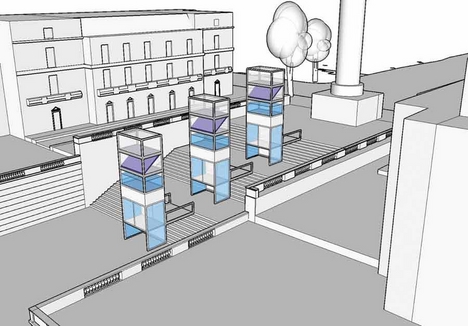
- Temporary solar-powered wheelchair lifts are to be installed at the Duke of York steps in London for the Festival of Architecture next year (via bd). Cool solution for the age-old historic buildings accessibility problem, and fitting modern look for the festival. Reminds me of my old post on a world without stairs.
Image: Computer drawing of the three-tiered Duke of York steps, with the mock-ups of three glass towers installed on the landings to house wheelchair lifts.


Friday, June 26, 2009

design and disability -- practitioner version

Royal Institute of British Architects announces new research project on disability inclusion IN the profession of architecture (i.e. inquiring into the status of architects w/ disabilities):
"This is an opportunity for all constituencies in the profession of architecture to hold up a mirror to their everyday attitudes, and re-evaluate the manner in which disability is treated in both architecture education and practice," commented David Gloster, Director of Education at the RIBA."

Saturday, June 13, 2009

link roundup: city life/facilities edition

San Francisco has unveiled some new bus stops with touch-screen (and audio enhanced) information screens and wifi hubs, once again putting my home city of New York to shame in their public transit accessibility and use of technology: they are currently in testing phase and 1,100 are planned.

The Dallas Morning News describes the experiences of an architect who spent 24 hours as a resident in a nursing home to understand the design issues

Chicago will open a National Public Housing Museum in the last remaining building in the WPA-era Jane Addams Homes. I wonder if there will be any discussion of disability issues, like the poor choices people with disabilities face in public housing and long histories of abuse in public hospitals/nursing homes.

Another tidbit of history: Penny Richards at Temple's Disability Studies blog spends some time in the Library of Congress' "Flickr Commons" and finds evidence of early 20th c. wheelchairs as a public convenience at the Bronx Zoo (much like at zoos/museums/etc today).

Tuesday, June 2, 2009

Old Houses


It's been a while since I lived in a HOUSE -- a free-standing, non-attached building where I have free range of 2 (3 counting basement) stories. I'm in Newark, DE, for a couple of weeks for the second annual Public Engagement/Material Culture Institute, a part of an NEH-funded program to support graduate students in sharing their research with a broader public. I am renting a room in the top of a small, mid-century (my guess would be postwar) house on a cute leafy street very close to campus. The neighborhood has similar Cape Cods and other revival-ish single- or multi-family houses, many of which are chopped up into collegiate apartments.

Pictured at right: the house where I am staying, a beige-stuccoed house with a low gable and a small awning over the stoop to the left of the picture. Plants are overflowing in the Delaware sun.

Being in this house I am immediately aware of the dimensions of houses built in the mid 20th century. These are modest spaces compared to the "great rooms" of McMansions and even the roving open living/family areas of 60s ranch-style homes. And the doorways: small. 30" doorways -- 32" is the ADA-compliant minimum-- and similarly narrow, as well as steep stairway. It's just a different scale than recent construction.

In the 1940s through 60s, when this housing type was increasingly common, filling the middle-class suburbs of postwar America, people with physical disabilities and their families had to take some creative approaches to make do with cramped spaces and narrow passageways. The polio-generation magazine the Toomey J Gazette ran pictures of a lot of these home-fixing projects, like a ramp pinned to the side of a house, with a trap door so the non-wheelchair-using household members could still use the steps.

(image from Toomey J Gazette, Spring 1961: three shots of a modest, clapboard house with a wheelchair ramp attached to the front. Images show a man pushing a woman in a wheelchair down this ramp; in the others, the man demonstrates how the middle of the ramp can be raised or lowered, adding or removing access to the stoop.)

Back in Newark, across the street from the house where I am staying there is a pretty non-descript rental house with a brick front and porch with a balustrade-- but no handrail down the few steps leading up to it. Someone has added one, a bright red number made of pipe parts. No doubt someone -- a landlord or a resident -- decided this house should be kinder to the tired legs that might be climbing up those steps.

Monday, October 27, 2008

architects riffing on ramps and etc

Image: Entrance to the Rotterdam Kunsthal, designed by Rem Koolhass' OMA: a gently sloping floor enclosed in walls of glass, with massive dark cement columns. A small ramp to the left leads up to a sign reading "entree."

A friend started this thread at Archinect asking about interesting examples of Universal (specifically wheelchair/walking accessible) spaces, sparking a wide-ranging discussion of what architects can, should, and do design for accessibility and inclusion. My quick observation-- some of the contributors to this discussion are quick to shut down the conversation with comments like "what would be the point" of designing a ramped area/space in a building that is not ADA compliant, or, alternatively, that buildings should not be the target of new design but that better wheelchairs and, indeed, re-engineered bodies should be the way to go. It strikes me that pointing away from the design problem is always an easy way to wriggle out of it. Yes, the ADA like all building codes can be shortsighted, but what does that mean-- keep addressing accessibility just as code and not as a real functional or formal issue in a building? Generally speaking, creative experiments may have gotten us all into a lot of messes but I still think it's worth it. I used the example of the Guggenheim in my post on the idea of a "world without stairs" knowing that Frank Lloyd Wright did not design its interior ramp with wheelchairs in mind-- but to show that the unintended consequences of design decisions can be delightful as well as disruptive (as in the case of the zillions of buildings/landscapes/products designed without thought of what they require of the body).

This thread also makes me more sensitive to the obstacles architects face to innovation, given that they have no more severe critics than their colleagues. And yet.. does all the criticism produce better architecture?

(side note-- Susan, if you are reading this, I can't comment on Archinect without being a member, but you might be interested in a few posts on Wheelchair Dancer's blog about her and her partner's and their architects' design process for ramps inside their house: for example 1 2 3.)

Saturday, June 7, 2008

a world without stairs?

I recently met the pioneering disability historian Paul Longmore at SF State, a true pleasure not only because his work on disability history has been so important to my learning, but because he talked to me for 2 hours about my project, asked all kinds of useful questions, and sent me on my way with a notebook full of notes and thoughts. Anyway, one thing he mentioned as we were talking about design, accessibility, universality, etc, was that the facilities director at SF State is entirely committed to universal design. When they started a renovation project for the library recently, and the architects came in to show their plans, the guy apparently took one look at the entrance they proposed and said (something like), "no, that won't work-- we don't do stairs at SF State."

It got me thinking after the conversation-- is an accessible world a world without stairs? Universal Design promises spaces designed for all, and advises, when possible, to avoid separate entrances and pathways for people using wheelchairs, walkers, etc. So a gently sloped entrance, or maybe an understory at ground level and an elevator, are preferable to a main entrance stair and a side ramp. In practice, the main thing this means is reminding architects to do away with the small, unnecessary sets of stairs that might make an otherwise pretty accessible place or building inaccessible (like 2-3 stairs on a park path or in front of a house or building). But what about as an entire design strategy? A few thoughts...

- The first thing that pops into my head is: is the Guggenheim in NY, completed in 1959, accessible? Or-- more precisely-- is its principal design focus, the long spiral ramp around an open atrium, universal?
Guggenheim. New York. c. 1975
Photo by ghougham on flickr.
(Image: a ghostly Guggenheim. Two long ramps sweep across the black-and-white image, with three small figures seen, one on the top ramp and two below.)

John Hockenberry describes the Guggenheim as "the most spectacular (if not the largest) indoor wheelchair ramp in the Western Hemisphere... Frank Lloyd Wright's personal gift to me and my manual titanium-frame wheelchair" (NYT, 1995). Was FLW aware of this angle-- or unconsciously aware, having lived through all of the 20th century, with polio, 2 wars, etc?

- The long descending ramp is a common theme in museum design, for example at the prize-winning Mercedes-Benz Museum in Stuttgart, completed 2001.
by Unstudio, & via Core77 Clogger. Image: architectural rendering of Unstudio's Mercedez-Benz Museum in cross-section, with ramps encircling the building to connect concrete-slab floors.

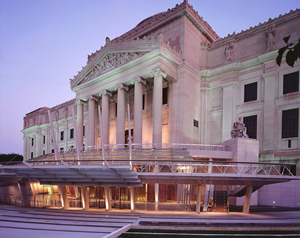
The Brooklyn Museum's renovation a few years ago put a new ground-level entrance hall below the grand temple-like stair of the original Howe and Lescaze building.
Image from Architectural Record
(Image: The Brooklyn Museum, a classical temple-style building complete with Greek pediment and Corinthian columns. Below the column facade is the new entrance, an open glass arcade at ground level.)
Entering gives the feeling of going through a catacombs, with heavy brick arches supporting the building, an apt sensation for the entrance to house of collections. I think the driving principle in the redesign was to make it more accessible in a community sense-- not the mansion on the hill, but a Brooklyn Museum that is open to Brooklyn. There are a lot of nice metaphorical angles to the idea of all of us getting in at the ground level. Shame is that they included a stepped atrium to get down slightly below street level-- the side paths are step-less, but the design misses its chance on the world without stairs.