A blog about universal and accessible design

Showing posts with label users. Show all posts

Wednesday, April 1, 2009

I have been slow to update this blog lately-- oh, the cycle of academic work and procrastination and guilt!

But here is what I've been working on..

The main work I have been doing lately is about the do-it-yourself and small-production technical work for and by people with disabilities during the 1950s-60s. This time period, I find, is interesting for the history of disability-related design because it is a kind of transition time: on the one hand, people with severe physical disabilities (spinal cord injuries, cerebral palsy, polio) were more and more likely to live long and healthy lives with mobility impairments. Medical professionals and policy groups advocated "independent living" as a better choice for recovery and social order, but living in homes and communities was not so easy for folks who used wheelchairs, canes, crutches, respirators, and had manual disabilities. As a result, a variety of gadgets and gizmos appeared to bridge the gap between the ambitions and interests of people with disabilities and the world that was not designed well for them.

A lot of these were published by doctors or other rehabilitation experts as part of an effort to ease the transition from clinic to home, like Howard Rusk and Eugene Taylor's
Living With a Disability (Blakiston Co, 1953), which featured low-tech options as make-your-own utensils with secure straps:
(image: black-and-white image shows forks and spoons with metal straps and finger sheaths attached to their handles, scattered on a black ground)

Rusk and Taylor also acknowledged the potential usefulness of new materials and gadgets of the postwar consumer culture, such as children's drink cups (aka sippy-cups) and electric razors.


(images: two layouts from Rusk and Taylor's book, with black-and-white images laid out around text. Left, three cups: one white plastic cup with a handle, one clear plastic with a white lid and with a hole and a straw, and one with and hand holding a cup with an attached metal handle with a large loop. There is also a clear plastic saucer on the page.

Right, a two-page layout with men shaving with electric razors: one uses a prosthetic hand, while the others hold handles and loops attached to the appliances.)


These kinds of technical fixes for day-to-day independent living also featured heavily in the content of the Toomey J Gazette, a publication "for by and about respiratory polios" that ran from 1958-1969 (before it became the Rehabilitation Gazette). The Toomey J allowed contributors a forum to share very personalized, creative approaches to making their mid-century home life work for wheelchair, respirator, and rocking bed living. The solutions were wide-ranging and sometimes fanciful, like:


(image: an ink drawing of an array of different mouthstick designs, each attributed to its designer. Splayed out in a fan from a central pair of lips, the materials include eye-dropper tips with dowels stuck in them, cigarette holders, even the rubber heel of a child's or doll's shoe to be held in the teeth. From the Toomey J Gazette, Spring 1960.)

Other contributions were more technical, like a Citroen 2 CV that had been cut up to make a flatbed platform for driving in a wheelchair: the car was equipped with two sets of hand controls and a swiveling floor so that the driver could turn around to drive in reverse, rather than having to crane his neck.
(image: three newsprint images of Fred Taberlet and his Citroen, a convertible-top car with an open space for driver and his wheelchair.)

In my dissertation, I write about these adaptations, adjustments, and inventions as part of the broader social context for the disability rights movement: this homespun work is a tacit assertion of the right for people with disabilities to operate and move within mainstream American spaces-- the "right to be in the world" that Jacobus tenBroek declared in a 1966 essay in the California Law Review.

I'll be talking about this research in two upcoming conference talks:

Technocultures and Identity Conference (Mid-America American Studies Association meeting)
Center for Ethnic Studies and the Arts, The University of Iowa
Friday, April 3, 12:30 pm
Panel: Medical Technologies and Identity
Kirkwood Room, 257 IMU
Chair: Michael Krysko (Kansas State)
“Chemical Technology and Emerging Identities: The Role of Technology
and Rhetoric in the Construction of the Hyperactive Child,” Jonathan
Hansen (Iowa)
“Technology and Disability Identity: The Toomey J. Gazette, 1959-1969,”
Bess Williamson (Delaware)

Material Culture Symposium for Emerging Scholars
Winterthur Museum, Wilmington, DE
Saturday, April 25, 3 pm
Panel: The Private Lives of Public Objects
Emily Voss, Cooperstown Graduate Program (Museum Studies)
"Astronauts, Aliens, Rockets, and Ray Guns: Space Toys and American Children 1950-1977"
Bess Williamson, University of Delaware (History of American Civilization)
"Doing It Themselves: Gadgets for and by People with Disabilities, 1945-1970"Drew Sawyer, Columbia University (Art History and Archaeology)
"The Queer Life of Crisco"Commentator: Peter Stallybrass, Professor in the Humanities and Professor of English and of Comparative Literature and Literary Theory, University of Pennsylvania

Wednesday, December 10, 2008

Arrogance will getcha


Image: Fiskars Rotary Cutter and Softtouch Scissors, designed by a team led by Jim Boda and Doug Birkholz, now of Inspire Design (image via Inspire).

I just had a nice chat with Jim Boda, who was head of R&D at Fiskars' US division in the early 90s when they developed Softtouch Scissors. Originally called the "Golden Series," the scissors were developed with the goal of making cutting easier for older users and people with manual disabilities. A spring in the scissors helps them open automatically, saving the effort and eventual discomfort of opening after each cut, while the innovative offset handles and straight bottom edge let you rest them on the table during use. Focus group feedback indicated that they would be useful and appealing to a broad range of users, and the new name reflected this comfort and ease. I see these every time I go to the fabric shop, as all the fabric measure/cutters use them.

Jim commented that, when it comes to designing tools/products, "one of the things that you really want to do is separate yourself—a lot of things can be intuitive, but in watching other people use products I find they really use them differently. We could design intuitively, based on own experiences, but when we get it wrong it's usually because of arrogance. Especially when it comes to the human body... we are all made up of different parts and use them in different ways." Thanks, Jim. He also mentioned that the US division was the first to really bring product innovation to the company-- with total market dominance in Finland, the home company didn't really understand the need-- and that US R&D helped the Finnish and British divisions set up their own design/R&D teams in the 90s. Interesting trans-Atlantic business story.

Friday, September 19, 2008

links


Image 1: From the NY Times today. A man and woman stand at adjacent cubicles, each with a treadmill installed under their elevated desks, talking on the phone and working.

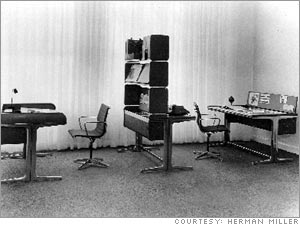
Image 2: From Fortune. In a black-and-white image of a modern office interior, two desks flank a bookshelf-like room divider, creating separate spaces with matching desks and chairs.

NY Times: treadmills in the office. You know how there are tons of coffee table books showing people in their houses, talking about the stuff they use for their daily routines? I would like to see more about office space and how people REALLY use them... specifically how people are working out the problem of sitting still all day. To me treadmills go along with adjustable chairs, ergonomic stools, and the variety of office equipment that is specifically designed so that people with disabilities can work in offices (or at home).
It reminds me of Herman Miller's Action Office, which, when it was developed in the 1960s, brought the possibility of flexibility to office design-- and despite the general disdain for cubicles at least they allow a little more flexibility than the static grid that preceded (which we can remember through the fabulous TV show Mad Men, furnished in vintage Herman Miller.. but I am getting off topic here).
Anyway-- the Times says that "still, to most, work-walking is 'a freaky thing to do,' said Joe Stirt, 60, an anesthesiologist in Charlottesville, Va., who works and blogs in his off hours while walking up to six hours a day in his home office." "Freak" is in the eye of the beholder, of course...

Wall Street Journal via Core77: New Open Solutions High-Tech Usability Lab. This article is a little business jargon-y but it's interesting to note how market research has changed over the years.. going from "what would you buy" to
Usability tests can be conducted on existing products and at key points throughout the creation of a new product including: during and after the design process, after it's been deployed and when it's deployed in a different cultural environment.
Figuring out WHO you design for and all the many people who might not quite fit with your initial assumptions is basically what usability is all about. I wish I could figure out what "high tech" methods they use to figure this out!

Core 77 blogger hipstomp is "missing the tactility" of flip-phones vs. the new movement in many phones toward touchscreens. I totally agree-- hands used to keyboards, not to mention shakier hands or ones that find it hard to hit touch-screens precisely will benefit from the choice of high-performance phones that have buttons on them. The Blackberry Pearl may end up being the choice of many who like the feel of flips and buttons over the slippery smooth iPhone.

Friday, July 18, 2008

personal histories of design

the design historian in me loooooves this history of chairs that has nothing to do with big names or evolution of styles:


A few quick things I take away:
- chairs are necessarily both visual and haptic things. No matter how high-design, hoity-toity a chair is, we seem almost always to ask under our breath, "is it comfortable?"
- the answer to that question is often as much about personal history as bodily experience
- it's surprising to me that he doesn't include wheelchairs

It got me thinking about personal histories of design.. artworks or writings that highlight how important particular tools are to how we express ourselves and live everyday. Here are some..

A fictional video-story of a fashionable woman and her walker, via Missability

Wheelchair Dancer discusses the importance of complete alignment in her wheelchair, making clear that the chair is not at all marginal to the dance.

Wednesday, June 25, 2008

fun little links

- I have always heard good things about the NYU Interactive Technology Program, and this wii-powered large-scale drawing tool for wheelchair users sounds awesome.

Digital Wheel Art from YoungHyun Chung on Vimeo.
via Wheelchair Dancer, who got a little test drive. The video is of a young man in a power wheelchair, moving back and forth controlling brightly colored lines across a digital canvas. At one point he says (subtitled) "I know what I am gonna do."

- I love people who use stuff and redesign that stuff to make it work better.
Vietnamese pedicab driver designs a better pedicab that (via Core77) "resembles a bicycle making love to a wheelchair."

- New design doesn't always fit old infrastructure.
The NY Times hits the hard issues: when ergonomic toothbrushes don't fit in ye olde toothbrush holder.

- Is the iPhone less usable for women because of "the fingernail problem"? (via UnBeige, who seem unnecessarily snarky about it. Only yokels complain about bad design?)