A blog about universal and accessible design

Sunday, October 26, 2008

people's design award winner


Zon Hearing Aid wins Cooper-Hewitt People's Design Award, a contest decided by online popular vote. An elegant, top-of-the-line (and top-priced) little gem. A sculptured, dull-silver wedge attaches behind the ear of this jewelry-like (though designed to disappear) hearing aid. Image above via zon (I'm not sure how to make a line above the o).

electronics of the future-- more touchy-feely?


I have posted a few times about how electronics can be hard to use-- touch screens, tiny numbers, etc. This is probably the #1 thing people mention when I talk to them about what products/spaces are inaccessible by design.

Image from C-Scout: hands demonstrating the smooth white Samsung Touch Sight Camera, which embosses images in Braille as well as providing a few seconds of sound to accompany each picture.

Here are some lovely prototypes for electronic gadgets designed for blind people and people w/ low vision. The article mentions a watch, a camera, a debit-card reader/PIN interface, and a Braille reader/writer that all integrate new digital approaches to tactile display. The article also mentions how these applications could improve usability for all, as is the mantra of Universal Design:
"Of course, many of these technologies can provide benefits to sighted people. For example, a tactile surface could be applied to a bedside clock, enabling one half of a couple to find out what time it is without disturbing the other."

Sunday, October 19, 2008

disability and metaphors

This is well-covered in the disability blog-world and in a lot of books on disability: disability and specific impairments are so often used in literature/movies/everyday speech as metaphors. I generally think of this as a thoughtless, uncritical thing-- for example, saying "blind rage" when you really mean something more specific. I like what Steven Kuusisto adds in a post about the movie "Blindness"-- here:

The film "Blindness" which is now in theaters offers the latest instance of what scholars David Mitchell and Sharon Snyder have called "narrative prosthesis" where in effect, disability is used as an artificial device to help what is otherwise a weak story line.

Blindness remains a frightening disability in no small measure because the literal condition, the disruption of the physical eye is invested with outworn symbolism that still resides in what the psychoanalyst Carl Jung called the cultural subconscious. People may know next to nothing about eye diseases but they know deep in their bones that there's something suggestive and darkly portentious about the blind.

[...]

There are of course real lives in the balance. As I have said many times previously on this blog the unemployment rate for the blind remains unacceptably high in the United States and around the world. The film "Blindness" or the execrable novel that birthed it are guilty of false disability figuration--aesthetic choices that can only further harm real people.


This also reminds me that I find "prosthesis" to be a really interesting metaphor too-- the collection Artificial Parts, Practical Lives: Cultural Histories of Prosthetics comments on this a little in ref. to Donna Haraway and other theories of technology and society, and it is prevalent in sci-fi too. I don't think we have to abandon all metaphors out of over-sensitivity... but I'm not sure how to unpack the meanings of prosthesis. I am also kind of intimidated by a lot of the theory that uses is, a la Haraway, so that probably doesn't help. I don't necessarily think being aware of disability (or any other social/political minority) issues means ending all use of metaphors-- it just means choosing words more carefully. Perhaps using "prosthetic" or "crutch" has different meaning if you really use a literal one.

as a side note, if I may gush, I love Kuusisto and his book Planet of the Blind-- which proves that one can talk about blindness in a lyrical way without resorting to lazy metaphor. I have been reading his blog for a while, and I love too the way he puts himself into the discussion-- in this recent post the title is "how many stories am I holding up?"; another time he joked about getting a t-shirt that said "I am not your metaphor." I dig it and would so like to take a class with him (he teaches writing and film at the U of Iowa).

Friday, September 19, 2008

links


Image 1: From the NY Times today. A man and woman stand at adjacent cubicles, each with a treadmill installed under their elevated desks, talking on the phone and working.

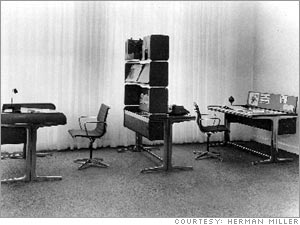
Image 2: From Fortune. In a black-and-white image of a modern office interior, two desks flank a bookshelf-like room divider, creating separate spaces with matching desks and chairs.

NY Times: treadmills in the office. You know how there are tons of coffee table books showing people in their houses, talking about the stuff they use for their daily routines? I would like to see more about office space and how people REALLY use them... specifically how people are working out the problem of sitting still all day. To me treadmills go along with adjustable chairs, ergonomic stools, and the variety of office equipment that is specifically designed so that people with disabilities can work in offices (or at home).
It reminds me of Herman Miller's Action Office, which, when it was developed in the 1960s, brought the possibility of flexibility to office design-- and despite the general disdain for cubicles at least they allow a little more flexibility than the static grid that preceded (which we can remember through the fabulous TV show Mad Men, furnished in vintage Herman Miller.. but I am getting off topic here).
Anyway-- the Times says that "still, to most, work-walking is 'a freaky thing to do,' said Joe Stirt, 60, an anesthesiologist in Charlottesville, Va., who works and blogs in his off hours while walking up to six hours a day in his home office." "Freak" is in the eye of the beholder, of course...

Wall Street Journal via Core77: New Open Solutions High-Tech Usability Lab. This article is a little business jargon-y but it's interesting to note how market research has changed over the years.. going from "what would you buy" to
Usability tests can be conducted on existing products and at key points throughout the creation of a new product including: during and after the design process, after it's been deployed and when it's deployed in a different cultural environment.
Figuring out WHO you design for and all the many people who might not quite fit with your initial assumptions is basically what usability is all about. I wish I could figure out what "high tech" methods they use to figure this out!

Core 77 blogger hipstomp is "missing the tactility" of flip-phones vs. the new movement in many phones toward touchscreens. I totally agree-- hands used to keyboards, not to mention shakier hands or ones that find it hard to hit touch-screens precisely will benefit from the choice of high-performance phones that have buttons on them. The Blackberry Pearl may end up being the choice of many who like the feel of flips and buttons over the slippery smooth iPhone.

disability politics


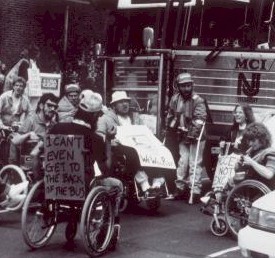
ADAPT public transit protest, Philadelphia, 1989. Image from the National Museum of American History's online Disability Rights Movement exhibition. Description: a black-and-white image of a crowd of people, many in wheelchairs, one at center with two canes, protesting outside a New Jersey Transit bus. In the foreground, we can read the sign on the back of one of the protesters' wheelchairs: "I CAN'T EVEN GET TO THE BACK OF THE BUS."

Memo to Governor Palin from Penny Richards:

Vice-president Cheney, by all accounts, loves his daughter Mary--but it doesn't make the administration in which he serves any friendlier to gay marriage or same-sex parents. And Sarah Palin, by all accounts, loves her little son--but that doesn't mean the administration in which she'd serve would set any priorities for the equality of people with developmental disabilities.

Paul Longmore, "What Kind of Advocacy Do People With Disabilities Really Need?":

In their convention speeches, Palin, John, and even Cindy McCain focused only on children. The media have talked almost exclusively about children too. What so many people seem to forget is that children with disabilities grow up to become adults. Ninety percent of the 54 million Americans with disabilities are adults. Most acquired their disabilities after childhood.

In addition, the media talk has mostly been about “compassion” not about “issues.” There has been little discussion about issues that matter to people with disabilities of all ages, issues such as health insurance, community-based personal assistance services, education, employment, and civil rights.

Finally, ADAPT is in DC right now with tents set up as DUH City (cleverly, HUD spelled backwards) to protest the lack of attention either candidate has paid to the problems of housing and poverty that many people with disabilities experience.


Friday, July 18, 2008

personal histories of design

the design historian in me loooooves this history of chairs that has nothing to do with big names or evolution of styles:


A few quick things I take away:
- chairs are necessarily both visual and haptic things. No matter how high-design, hoity-toity a chair is, we seem almost always to ask under our breath, "is it comfortable?"
- the answer to that question is often as much about personal history as bodily experience
- it's surprising to me that he doesn't include wheelchairs

It got me thinking about personal histories of design.. artworks or writings that highlight how important particular tools are to how we express ourselves and live everyday. Here are some..

A fictional video-story of a fashionable woman and her walker, via Missability

Wheelchair Dancer discusses the importance of complete alignment in her wheelchair, making clear that the chair is not at all marginal to the dance.

Wednesday, July 9, 2008

playgrounds

Image from NY Times: a 5-year-old boy in a baseball cap sits in a wheelchair to the left of the frame. His mother holds his hand as he reaches for a bright green digger at a playground sandbox.


When I was in San Francisco recently, I was amazed at the huge and fun playground in Golden Gate Park-- there were so many different options there that would have been fun for a lot of different sizes/shapes-- in fact I had a hard time restraining myself (and didn't much) from playing on the spinning flower-shaped chairs or climbing the big rope spiderweb myself. I was thinking that the spacious rolling rubberized landscape was uncluttered enough that kids and parents with wheelchairs could get around, and there were options at different levels that would be fun for people with various impairments.

This NY Times article
reports on how hard it is to fund accessible playgrounds, but that a few organizations have pulled it off in the Northeast (this is a regional article). The emphasis is on play spaces that can be used by everyone, and several parents quoted in the article mention the problem of going to playgrounds that are accessible only to some of their kids.
- Boundless Playgrounds has helped CT and NJ communities build playground with things like raised sandboxes so kids in wheelchairs can play and toys like the extended-arm shovel in the image.
- Miracle Fields is an organization that builds accessible baseball fields-- 4 in the NY region and more than 10 planned, says the article.